
Everyone says they’ll buy in a downturn. Few actually do
In just one month, our market has made a complete shift. January started out strongly in Melbourne, with strong investor enquiry and first home buyer activity defining the start of the year.
But throw in two interest rate hikes, a US led Middle Eastern conflict, a pinch of inflation wows, a shake of wallet shock at the bowser, and threats of petrol rationing….. things have gone from go to whoa very quickly. Our auction clearance rates are down, and many investors have pulled back their plans to buy.
When consumer confidence dips, headlines tend to grow louder, sentiment becomes cautious, and buyers retreat to the sidelines. It’s a familiar pattern, and one that seasoned property professionals have seen play out time and again. While it can feel uncomfortable in the moment, periods like this often present some of the most compelling opportunities for strategic property buyers.
Today’s market conditions like are ripe for contrarian investors.
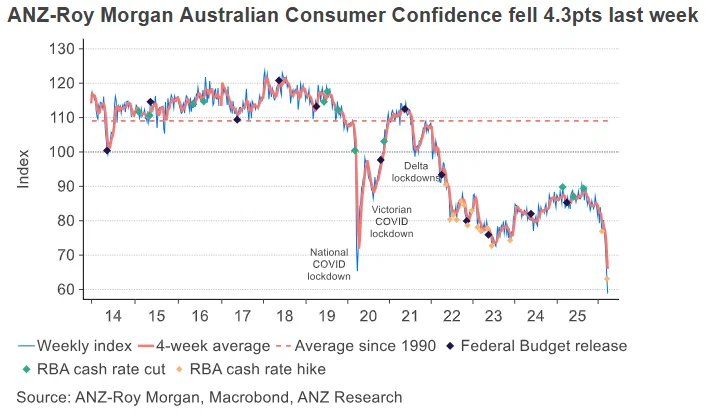
We’re seeing confidence levels at notable lows. The Roy Morgan/ANZ consumer confidence shows current sentiment sitting below that of the COVID era. This is precisely the kind of environment that many buyers claim they’re waiting for. And yet, when it arrives, hesitation often takes over.
The irony is hard to ignore. For years, buyers talk about wanting to “time the market”; to purchase when conditions are favourable. This is when competition is thinner, and when there’s a greater chance to secure a property without emotional bidding pressure. But when that window opens, fear can cloud decision-making.
It’s important to separate sentiment from the fundamentals.
Australia’s residential property market has demonstrated remarkable resilience over the long term. When we look back at historical downturns, a clear pattern emerges. Downturns tend to be shorter and shallower than the growth phases that follow. Property values may soften temporarily, but the recovery periods, (and subsequent growth cycles) have consistently outweighed those declines.
This isn’t to suggest that all markets move in unison, or that every asset performs equally. But the broader trend underscores an important principle; time in the market has historically proven more powerful than timing the market perfectly.
Periods of low consumer confidence coincide with reduced competition. Fewer active buyers means less competition at auctions, more negotiable vendors, and, in many cases, improved access to quality stock. Vendors who choose to sell in these conditions are often more realistic about price expectations, particularly if they are motivated by life events rather than opportunistic timing.
For buyers, this creates a window where careful due diligence, action, and strategy can deliver exceptional outcomes.
In stronger markets, desperate buyers can find themselves making compromised decisions. Stretching budgets, waiving conditions, or settling for inferior asset simply to secure a purchase. In contrast, a softer market allows for a more considered approach. Buyers can take the time to assess location fundamentals, evaluate their shortlisted options, and negotiate/approach auction with greater confidence.
This is where experienced guidance becomes critical. Not every property represents good value, even in a subdued market. The focus should always remain on acquiring an asset with strong long-term fundamentals. These all include: a desirable location, scarcity, land value, and broad appeal to future owner-occupiers.
It’s also important to note that confidence is cyclical. Consumer sentiment doesn’t remain low indefinitely. As interest rate expectations stabilise, economic conditions improve, or simply as buyers adjust to the “new normal,” confidence begins to rebuild. And when it does, competition returns, and often quickly. We can all recall what happened after the pandemic was announced. Many will remind me that interest rates dropped to an all time low, but the decision to buy went from whoa to go in a three week period.
I cast my mind back to past cycles. I remember making a contrarian purchase in December 2008. I was a mortgage broker at the time, and my manager warned me that the GFC posed an enormous threat to my acquisition plans. I recall telling him that I had the deposit funds on hand, and I wanted to buy a home for our family. We’d been rent-vesting, and the changed market conditions enabled us to purchase a home on the beach side of the highway in Aspendale. This was something I’d wanted to do for years.
I had family telling me I was impetuous. My friends thought I was mad. I had a boss telling me that the market could drop 30%-40%, as it had in Ireland, the US and parts of Europe. The broadsheet news was terrible.
I bought the house for $310,000. It had been advertised on market for $380,000, and a series of price reductions to $350,000 caught my eye. Our settlement period was short and we settled in January 2009.
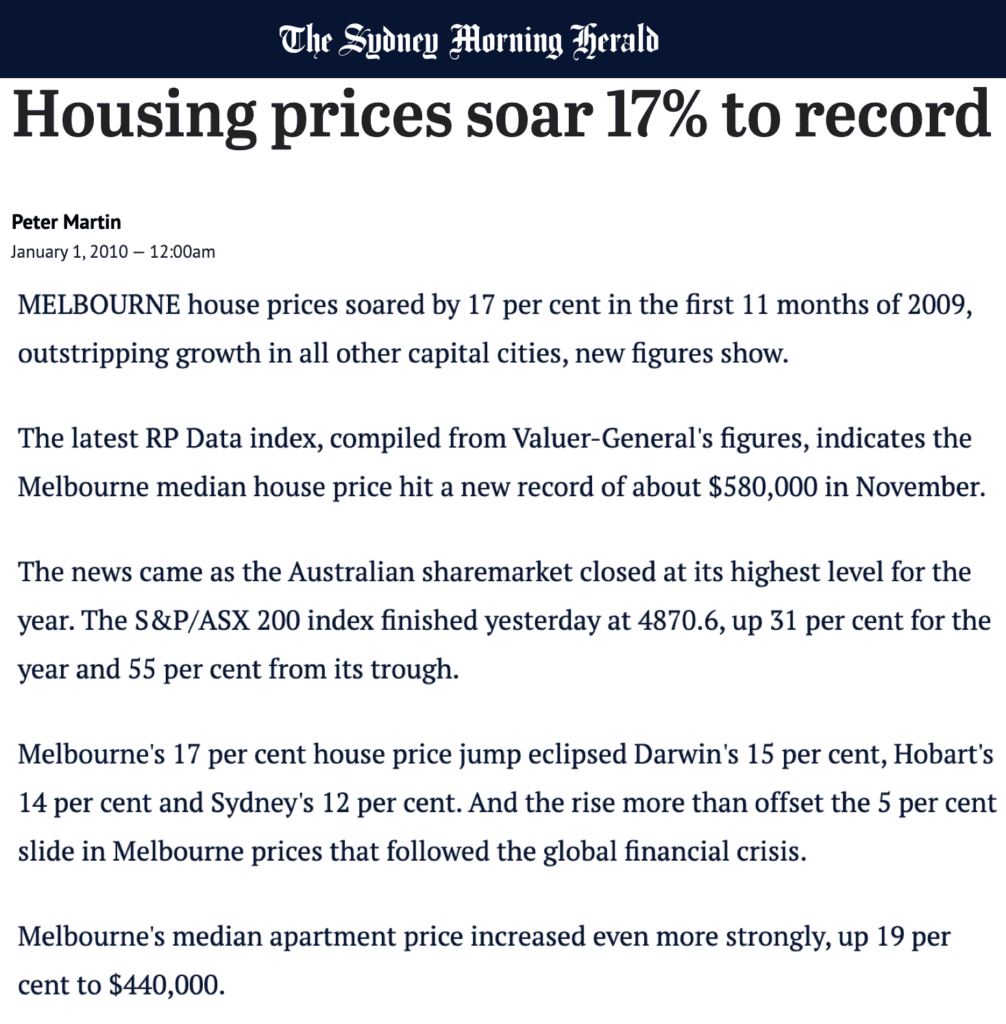
The Melbourne property then soared.
Markets can shift gears faster than many expect. Often, buyers who wait for certainty find themselves re-entering a market that has already begun to move, facing renewed competition and upward price pressure.
Opportunity in property rarely presents itself with perfect clarity. More often, it appears during periods of uncertainty. This is when when the broader market is hesitant, but underlying fundamentals remain intact.
For buyers with secure financial positions, a long-term outlook, and a clear strategy, this is potentially their moment.
It’s also an opportunity to reframe how we think about “timing.” Rather than attempting to pick the exact bottom of the market, (a near-impossible task), the focus should be on identifying favourable conditions and acting decisively when they arise.
I didn’t know I’d perfectly timed my purchase in December 2008. At the time, it was hard to tell how much worse things could get. But my motivation was to purchase the product that I could finally reach. The market conditions enabled this ‘beach-side of the highway’ house to finally be within our grasp.
In many ways, today’s market aligns closely with what buyers say they want: less competition, more choice, and greater negotiating power. The challenge lies in having the confidence to act when sentiment is subdued.
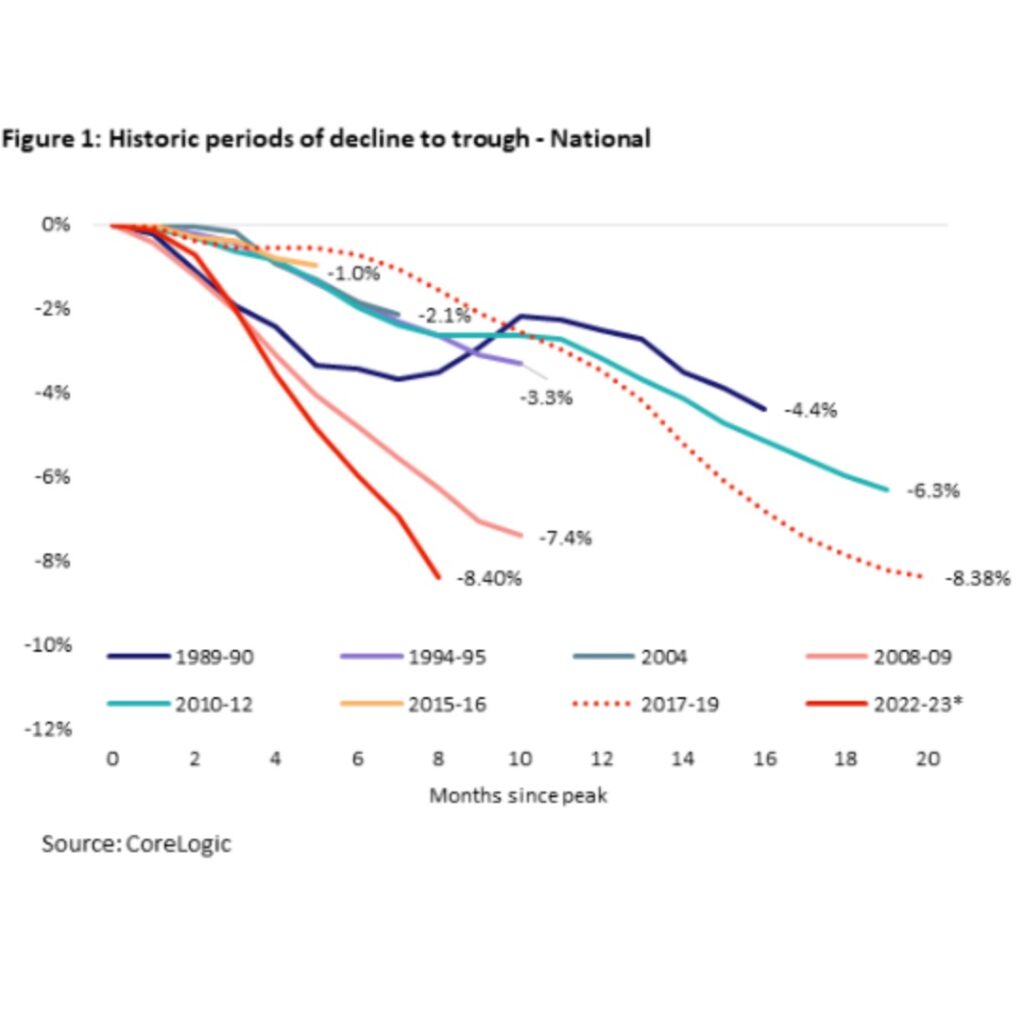
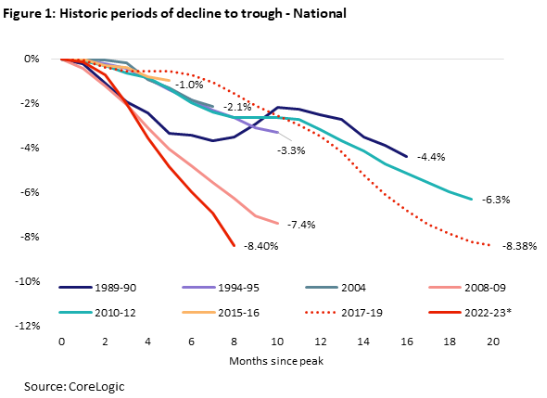
This chart below shows the Australian property market downturns spanning the last forty years. The x-axis shows the timeline of each downturn, and the y-axis shows that the most significant price dip was our most recent downturn over 2022-2023. This particular downturn was spurred on by rapidly increasing interest rates in an inflationary environment. The period of time was eight months, with a national market downturn of 8.4%. Each of the other downturn periods, from GFC to the 2017-2019 credit crunch, post-mining boom and 1990 recession did not cause price falls beyond the most recent downturn.
Cyclical fluctuations are part of the property investing journey, not a reason to avoid it.
For those willing to lean into the current conditions, rather than retreat from them, there is genuine opportunity to secure quality assets under less pressure and competition.
And in years to come, when confidence has returned and prices have moved accordingly, these quieter moments are often the ones that buyers look back on with the most appreciation. Just like me and my GFC purchase.
Because while everyone says they want to buy when the market is soft, only a small portion actually do.
And that’s where the opportunity lies.