
Where the most advantageous property transacting opportunity sits in Melbourne
I had a call this week from a client who has been contemplating a home upgrade for the better part of a year. Her question was the one I hear almost daily right now: “Is this actually a good time to buy, or am I about to make a mistake?”
I understood the hesitation completely. The headlines don’t help, but when I walked her through the possible process and the numbers, her fear changed quickly.
There is no doubt that Melbourne’s market performance has been lacklustre for the past five years, but the opportunity in a buyer’s market is often advantageous for upgraders. This market is no exception.
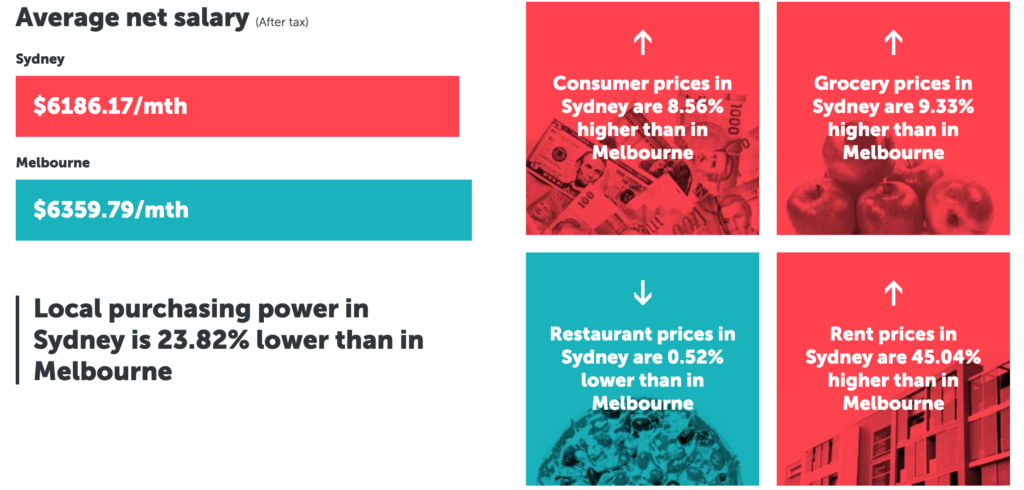
CoreLogic has Sydney’s median house price sitting well north of $1.4 million, with Melbourne’s closer to $980,000. That’s a gap of around half a million dollars, the widest split between our two largest capitals in more than two decades. Melbourne is currently trading at roughly 65% of Sydney’s median, well below the long run relationship of closer to 78%. Markets trends this don’t stay at a low ratio forever, and for buyers transacting in Melbourne today, the relative value proposition matters more than any single headline about a soft quarter. Sydney is just one city demonstrating this stark ratio. Melbourne’s parity against other capitals, (including Brisbane and Adelaide) also showcases the relative value proposition of our city.
Why the gap opened up
Melbourne has had a flatter run than Sydney, weighed down by a string of rate rises, a continual array of investor disincentives, (land tax and rental reforms to name two), a state government deficit, a post-COVID hangover, and a solid pipeline of new housing supply that has kept a lid on price growth even as rents have climbed hard. Sydney, by contrast, has kept moving on tighter supply and a much smaller pool of detached housing. Melbourne’s value proposition here is stronger than it has been in a long time.
Why a flat market actually favours the upgrader
This is the part my client hadn’t considered, but walking her through the equation put her dilemma into perspective. When the whole market softens, an upgrader is not just selling into quiet conditions. They are buying into them too.
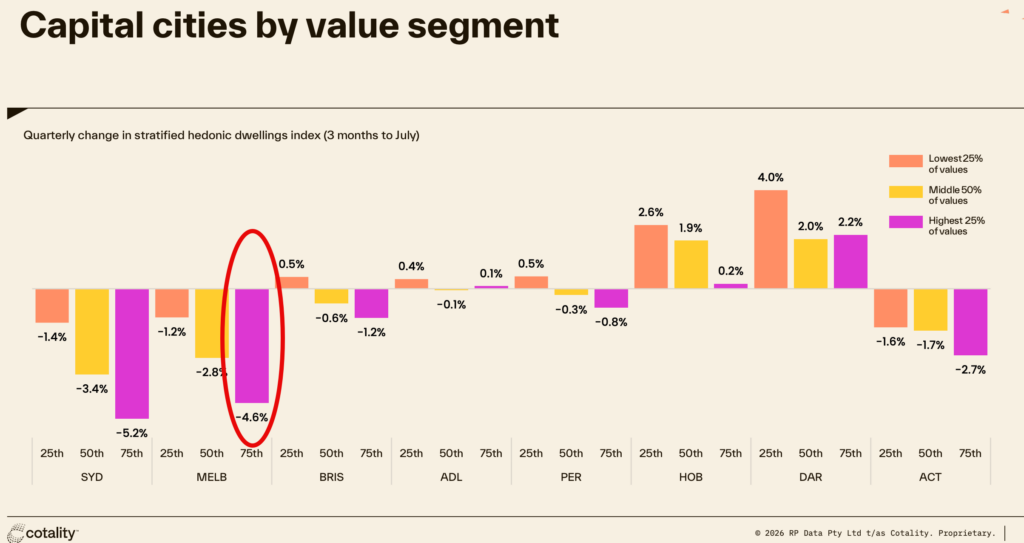
As an example, if her current home has lost 5% of it’s value over the past year, but the home she’s upgrading into has declined at 7% (highly possible given the top quartile has been the most responsive to harsher economic conditions), our prospective buyer could be trading advantageously. The percentage ‘loss’ will be far outweighed by the percentage ‘gain’ in terms of the relative discount on the purchase price. Conversely, in a booming market, upgrading from a $900,000 home to a $1.3 million home means that $400,000 gap can grow uncomfortably fast, because the bigger number is likely moving on the same percentage terms.
A buyer doesn’t need to pick the top of the cycle to come out ahead. Merely trading concurrently will likely deliver an advantageous result for an upgrader.
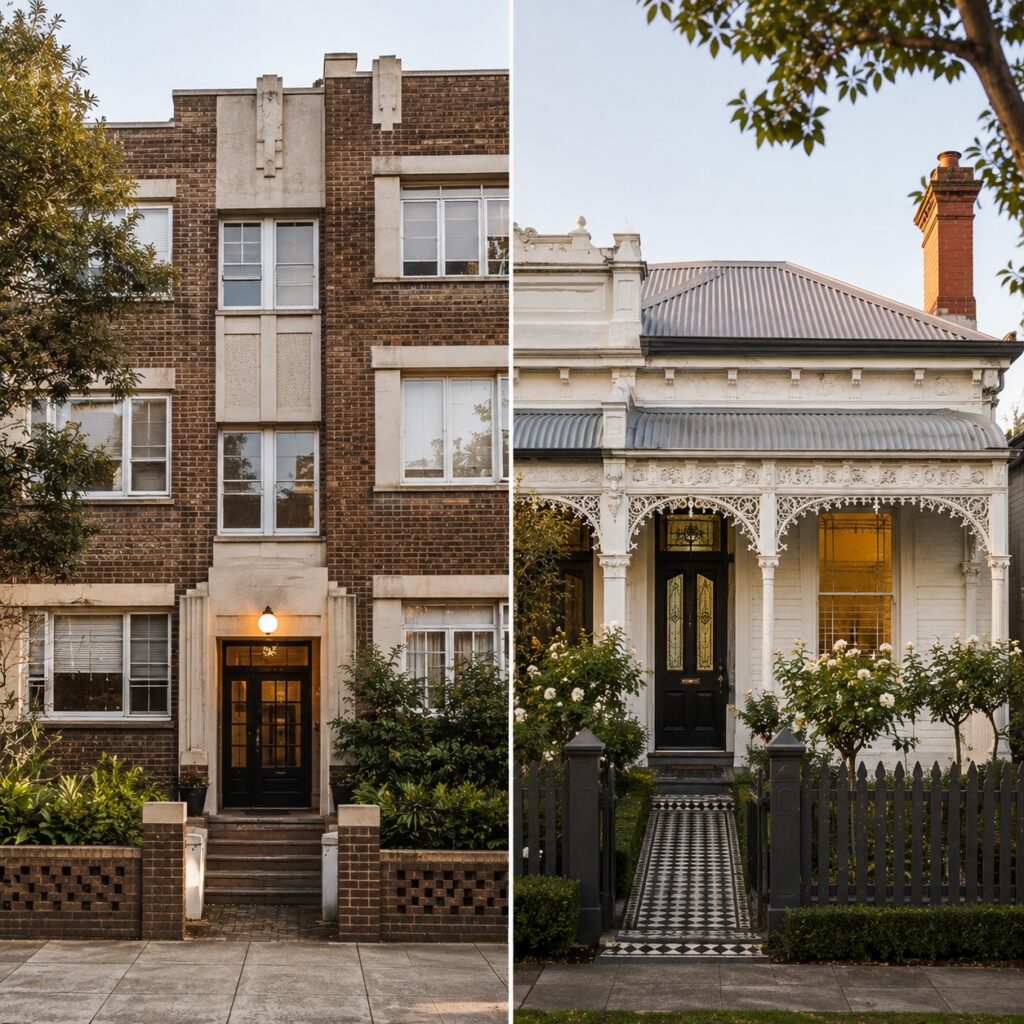
Interestingly, the unit market in Melbourne has recently outperformed the house market; a trend that we have not seen in the last decade. The relative disparity of market conditions for the upgrader may translate into semi-favourable selling conditions, depending on the style, age and density of the strata property they are selling.
Add in less competition at auction, more properties sitting on the market a little longer, and vendors who are genuinely open to a conversation rather than a bidding war, and the market presents conditions that quietly favour the buyer who’s ready to move…. not the one who waits for a headline to tell them it’s safe.
Interstate buyers have already worked this out
ABS migration data shows Sydney recorded a net interstate outflow of around 33,000 people over the past financial year, and a meaningful share of that group has landed here in Melbourne, drawn by exactly the value proposition I’ve described. I’ve had more than one client tell me they simply couldn’t justify staying in Sydney once they worked out what the same budget could buy them here. Examples include a family home in Coburg or Reservoir instead of a cramped two bedroom unit. It’s part of what’s keeping vacancy rates so tight across the inner north, sitting around 1.4% by the latest figures.
I don’t think Melbourne home-upgraders need to feel nervous about “catching a falling knife.” What I’d encourage instead is a shift in thinking. Buyers do not need to pick the exact bottom of the cycle. They just have to mitigate their risk by transacting concurrently if their upgrade property is in the same market.
If an upgrade has been sitting on minds of any homeowners, this is one of the more sensible times I’ve seen in a while to actually run the numbers rather than shelve the idea for another year. As always, I recommend getting finance approval sorted early, conducting due diligence properly, and avoiding letting the noise around “market uncertainty” cloud judgement.