
Do Better Schools Really Mean Higher House Prices? The Evidence from Victoria

I regularly speak with buyers who include this in their key criteria: “We want to be in a top school zone.”
Sometimes they have children, sometimes they don’t. And increasingly, investors are adding it to their criteria too.
It’s understandable. The idea of securing a strong public education without private school fees is compelling. In Melbourne, we’ve seen time and again that buyers are willing to pay a premium to achieve it. In fact, as I’ve written previously, double-digit price surcharges in premium school zones are common.
But are buyers paying a premium that is justified? Or one that is simply assumed?
I had an eye-opening interaction this past week when an analyst approached me with his research on this very topic.
Liam emailed me after having read my earlier blog.
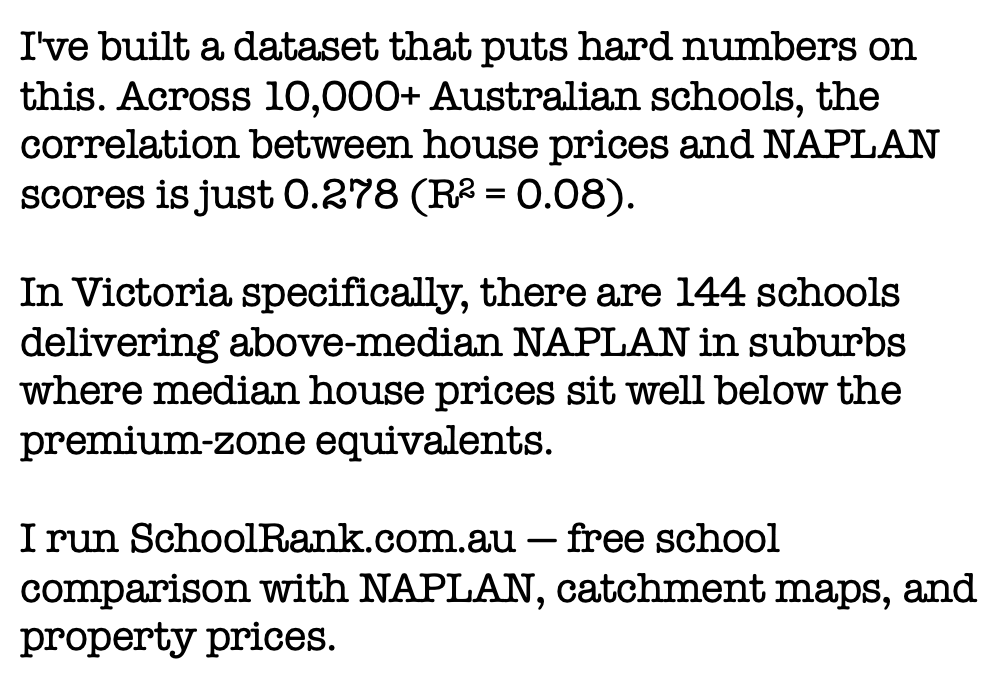
Liams data shows that there is a correlation between school performance and house prices.
But it’s weak.
- Correlation: 0.278
- Only 8% of price variation explained by school performance
This is critical, because if school quality were the dominant driver of price, the relationship would be strong. A correlation coefficient of under 0.3 is considered weak.
What we actually see is this:
- A handful of well-known school zones command significant premiums
- Many others do not
- And some affordable suburbs outperform expectations academically
This explains the disconnect. At a micro level, within a tightly held zone, the premium is obvious. But across the broader market, it becomes diluted.
In fact, research has shown that while buyers may pay significantly more to enter a catchment, those properties don’t always deliver stronger long-term capital growth.
“In Melbourne, the premium for homes in the catchments of Princes Hill and University High School reached $357,000, though capital growth was weaker than in surrounding suburbs.
This was not the case across the board however, with the report finding school catchment zones that were cheaper.
Ms Owen said being near a good school did not exactly translate to higher prices.” (Source: Country News, 25 July 2025).

I often see buyers make one of two mistakes.
Overpaying for the zone
They secure the postcode, but compromise on:
- Land size
- Property type
- Future proofing
As I’ve cautioned before, a small apartment in a prized school zone won’t necessarily appeal to families later. There is little point targeting such a dwelling type primarily due to being in a school zone.
Assuming the zone guarantees growth
There is a common belief that:
“If I buy in a good school zone, capital growth will deliver outperformance.”
Capital growth doesn’t hinge on school zone though. Growth is driven by:
- Supply and demand dynamics
- Income growth
- Infrastructure
- Gentrification
School zones can contribute, but they are rarely the dominant force.
But getting back to Liam’s study: the weak correlation doesn’t mean school performance is irrelevant.
It means that the market is inefficient, and this inefficiency creates opportunity for those who have schooling firmly on their criteria list.
Liam’s study has identified the following;
- Suburbs with solid or improving school performance
- Suburbs offering great schools with lower price points and less competition
These are the areas where;
- The “school zone surcharge” hasn’t fully materialised
- Future demand has room to grow
These are the locations that are delivering high value schooling options when contrasted to property prices. The school zone surcharge is real, and in some cases, it’s entirely justified. But it’s not universal, and it’s not always rational.
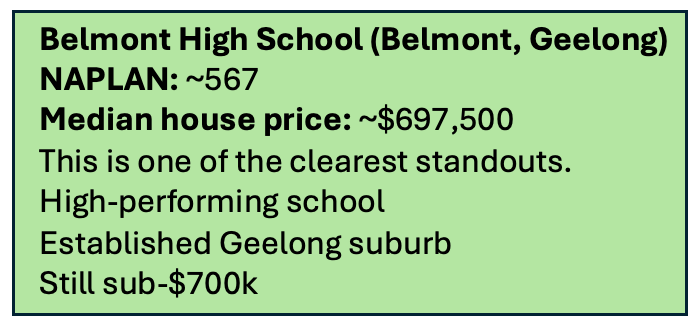
Liam’s data also tells us:
- School performance has a limited influence on prices overall
- Premiums are highly localised
- And paying more doesn’t necessarily mean buyers will achieve better growth
For families, the decision may be emotional, and that’s perfectly valid. But for buyers who are thinking pragmatically about property, it’s worth diving into the data and asking
At a macro level, the correlation coefficient of 0.278 demonstrates that the relationship is diluted. Why is the correlation so low?
- Many affordable suburbs still have decent schools
- Many expensive suburbs don’t have standout schools
Ultimately, the premium prices is a demand story, not a performance story.
The premium exists because:
- Families want to avoid private school fees
- There is limited access (zoning constraints)
- Buyer urgency is high (kids = deadlines)
This creates emotional buying, competitive pressure and hence, price escalation. The market clearly values access to non-selective, zoned public schools. But the data suggests that there are plenty of great schools on offer, and in locations at a fraction of the price.
The danger of over-weighting school scores
For buyers, (particularly investors), this is where caution is required. Relying too heavily on school performance as a proxy for growth can lead to:
- Overpaying in already tightly held markets
- Missing opportunities in emerging or overlooked suburbs
- Confusing demand today with growth tomorrow
It’s important to distinguish between price pressure and capital growth.
A strong school zone can absolutely create competition. But competition alone doesn’t guarantee superior long-term growth. In fact, some of the strongest growth periods occur in suburbs where demand drivers are improving, not already fully priced in.
Thank you to Liam Maurer, for introducing this study and also bearing with my correlation questions.
Link to Liam’s site here.