
In 2012, I found the house that I’d never want to leave

I popped up a post the other day on socials and I got a lot of responses. Some people reached out, and it made me appreciate that what I have is very special. Not only that, many people wish they could have this kind of affinity with their own home.
When people think about buying a home, they often picture the end result. A beautiful kitchen, a sunlit living room, a street they feel proud to call their own. What’s less visible, but far more important, is the groundwork that happens before a single property is inspected. Getting the brief right is the difference between a purchase that feels considered and one that feels compromised, months or years down the track.
For many households, the family home is not just an emotional purchase. It is the largest and most valuable investment they will ever make. That alone elevates the importance of a well considered brief. This is not a decision that should be shaped by impulsive actions or short term thinking. It requires structure, discipline and a clear, yet feasible criteria set.
For owner occupiers, the brief is not simply a wish list. It is a carefully constructed framework that balances lifestyle needs, both now and into the medium-term future, and capital growth performance. Too often, buyers rush this stage. They start attending inspections with only a loose idea of what they want, and before long they are reacting to properties rather than assessing them.
A strong brief should be deliberate. It requires focus. And importantly, for couples, it needs them to be on the same page.
I encourage my clients to think about their brief in layers. The first layer is the non-negotiables. These are the elements that cannot be compromised without fundamentally affecting daily life. It might be proximity to work, access to a particular school zone, or the need for single level living. These are not preferences, they are requirements.
The second layer is value drivers. This is where an owner occupier brief should draw heavily on genuine investment-grade principles. Even though the property is a home, it still represents a significant financial commitment. Attributes such as land component, position within the suburb, streetscape, neighbouring dwellings, easements, overlays, orientation, natural light, and scarcity all matter. These are the fundamentals that underpin long term performance and future buyer appeal.
Resisting compromise on these elements is essential. Not just to ensure the home serves its purpose for many years, but to protect the asset’s ability to grow in value. When buyers dilute these fundamentals, they risk limiting both their enjoyment of the home and its long term performance.
The third layer relates to personal style preferences. This is where emotion comes in. Architectural style, the level of renovation, street appeal, and the feel of a home all sit here. These elements are important because they shape how a buyer connects with a property, but they should sit behind the more critical layers.
When these layers are clearly defined, decision making becomes far more structured. Buyers can quickly identify whether a property aligns with their brief or whether it is simply appealing on the surface.
One of the biggest challenges in crafting a brief is future proofing. It is easy to focus on current needs, but a home purchase should ideally accommodate the next phase of life as well. This might mean allowing for a growing family, considering work from home requirements, or thinking about how long the property will realistically serve its purpose.
Future proofing does not mean predicting every detail of the next decade. It means building flexibility into the brief. For example, a floor plan that can adapt, a location that offers multiple schooling options, or a property with potential to extend or improve. These considerations can significantly extend the lifespan of a home and reduce the likelihood of needing to transact again too soon.
Another critical aspect of getting the brief right is discipline. A well constructed brief will inevitably lead to the rejection of many properties. This can be frustrating, especially in competitive markets where options feel limited.
However, saying no is a powerful part of the process.
Every rejected property brings more clarity. It reinforces what matters and what does not. It prevents buyers from drifting away from their core criteria and making reactive decisions under pressure. In my experience, the clients who are most satisfied with their purchase are the ones who were prepared to walk away multiple times.

That said, the biggest regret can strike when a high-scoring property comes along in week one. It’s not unusual for buyers to reject a great option that came along earlier than they were mentally prepared for. I often hear, “it’s perfect, but it’s only the first week.” Recognising a great property is only one part of the equation though. Understanding the likely frequency of another coming along is vital.
A clearly paved-out strategy will identify the relative ‘scarcity’ of the brief.
It is also important to acknowledge that no property will score 100%. It may meet the brief perfectly through.
There is no such thing as a flawless home. The key is understanding where compromise is acceptable and where it is notThis is where the earlier layers of the brief become invaluable. Compromises should sit within the lifestyle preference layer, not within the non-negotiables, or the core value drivers. For example, a buyer might compromise on an outdated kitchen if the location, land component and floor plan are strong. They might accept a smaller yard if the property is in a tightly held area with excellent parkland nearby.
What should be avoided is compromising on elements that cannot be changed. Position, orientation, and underlying land value are fixed. These are the attributes that should be protected at all costs.
There is also a psychological element to accepting compromise. Buyers need to feel comfortable that they have made a considered decision, not a rushed one. When a brief has been thoughtfully developed and consistently applied, it becomes much easier to accept a property that meets the must-have criteria.
Over the years, I have seen how powerful a well defined brief can be. It creates clarity in what is often an emotional and complex process. It helps buyers remain grounded when competition intensifies. And ultimately, it leads to better outcomes.
The goal is not just to buy a home. It is to secure a home that continues to serve and satisfy long after the excitement of the purchase has passed, while also performing as a strong, long term asset. A home that feels right not only on auction day, but five, ten, even twenty years later.
It requires clarity and patience, because the right property will not always appear immediately.
But when it does, and when it aligns with a well considered brief, the decision becomes far clearer. And that is when buyers can move forward with confidence, knowing they have set themselves up not just for a successful purchase, but for a home that will stand the test of time, both as a place to live and as a valuable long term investment.
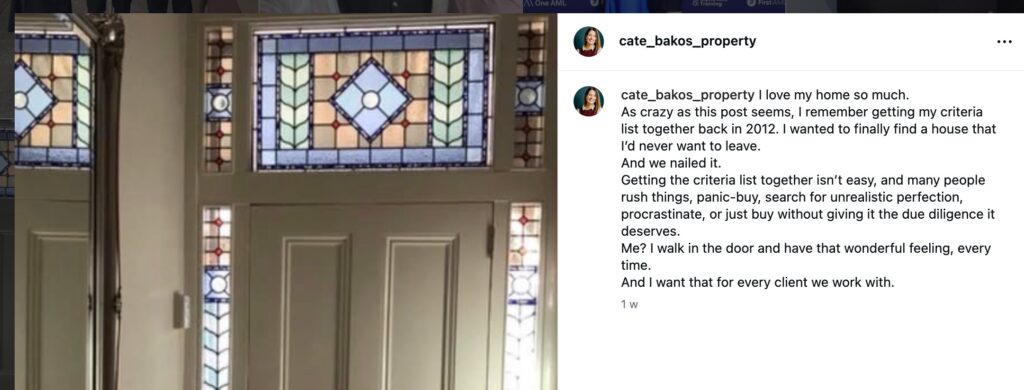
“Getting the criteria list together isn’t easy, and many people rush things, panic-buy, search for unrealistic perfection, procrastinate, or just buy without giving it the due diligence it deserves.
Me? I walk in the door and have that wonderful feeling, every time.
And I want that for every client we work with.”