Melbourne’s Most Unusual Property Downturn: A Buyer’s Agent’s View

I have been a buyer’s agent for almost seventeen years. Prior to this, I worked in finance as a mortgage broker. Over this time, I have worked across six local property downturns.
It’s fair to say that this particular downturn is the most unusual I’ve experienced.
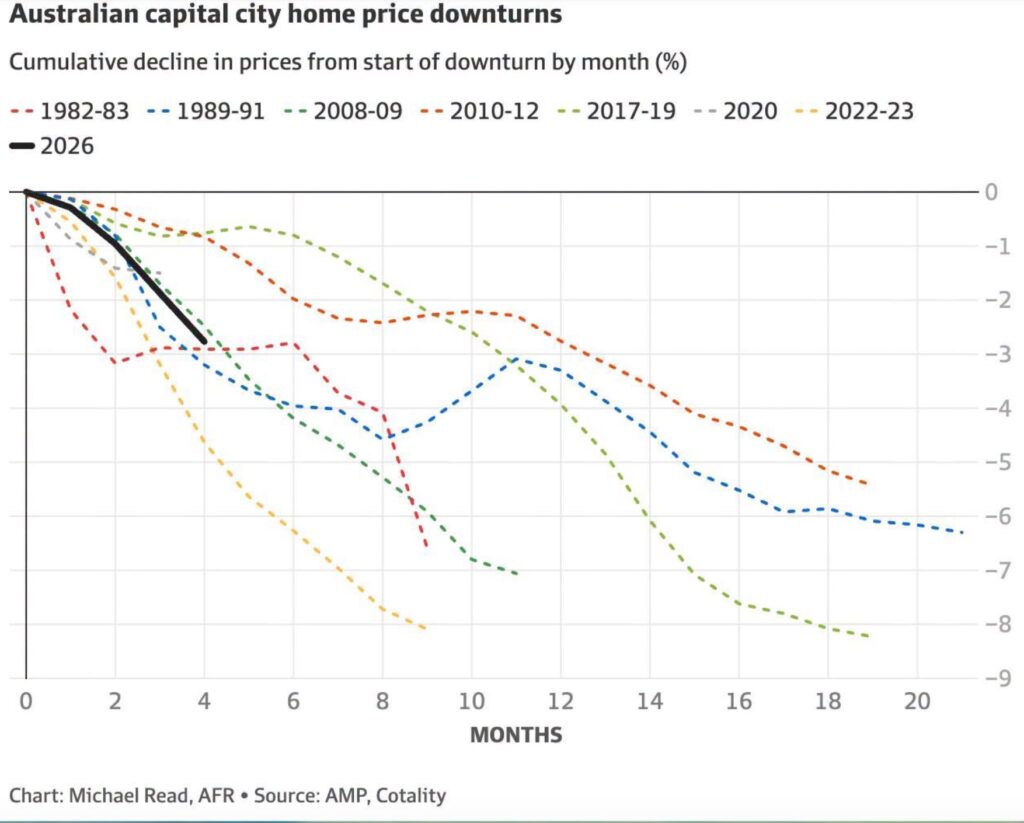
For whatever reason, my Melbourne property enquiry is strong. Sentiment is low, yet many prospective buyers think that Melbourne is poised for a recovery in the not too distant future. Some subscribe to the Mean-Reversion theory, while others are wondering what a change of government for Victoria would spell.
And at the same time, investor borrowing capacity has nose-dived due to the negative gearing changes. Previously, a $800,000 property investor who targeted an established three bedroom house on 600sqm of land could anticipate an annual cashflow shortfall around $25,000 per year, depending on their interest rate and loan type. Nowadays, that same investor would be facing closer to a $50,000 annual shortfall. For most, this is not economically viable.
Interestingly though, investors aren’t queuing up en masse to buy brand new dwellings either.
“Property investors are pulling back sharply from Australia’s housing market, while Australians buying homes to live in are proving more resilient.
New lending to property investors fell 32.3% in the September quarter, the largest quarterly decline since records began in 2002, data released by the Australian Bureau of Statistics shows.
The number of new investor loans also fell 30.6%, reinforcing the scale of the retreat.
By comparison, the value of new lending to owner occupiers excluding first home buyers fell 5.3% over the quarter, while lending to first home buyers declined 8.0%. ” (Source: Commbank, 12 November 2026).
Let’s consider the Melbourne property market’s statistics for growth, segmentation and new listings. This tells an interesting story.
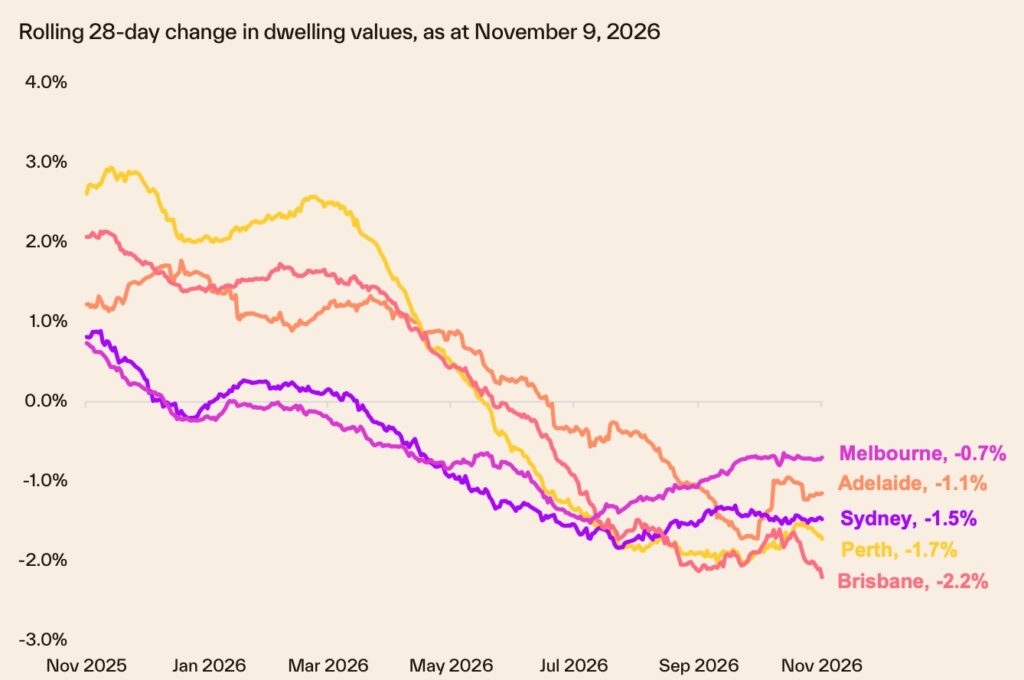
Firstly, while the property market recorded sales are still showing a declining market, there are two important things to note. The rate of decline in Melbourne is less than other capitals. Secondly, the data is not always up to the minute. Many sales results are captured when the property settles and the sale is then recorded at the Valuer General’s Office. The lag effect can be up to three months or more for many sales. The question becomes; are we looking at current data, or is this a reflection of the past couple of months?
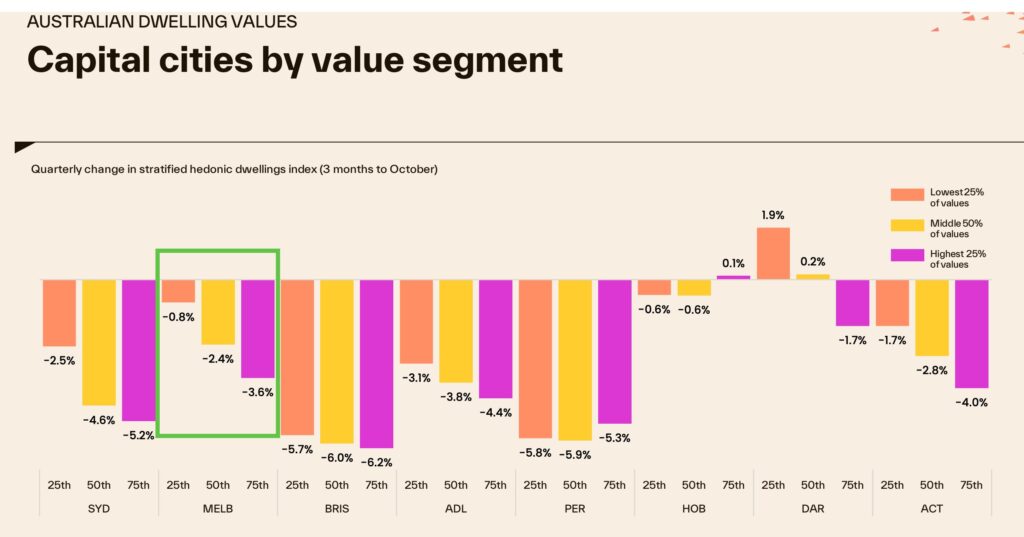
Thirdly, we must consider segmentation. Not all markets perform the same across the price segments, and this downturn shows that nationally, price falls in the higher price segments are almost completely consistent across all capital city markets.
This does create a question for lower-priced properties in Melbourne. How advantageous are the buying conditions for those who are focusing on the bottom quartile price points? These buyers are typically first home buyers, but more recently, they are also investors who are seeking higher yields.
Competition levels in the sub $750,000 market have been tougher than most would imagine.
And listing activity is the metric worth noting. Our new listings in Melbourne are some 30% lower than the same time last year. This begs the question: why are Melbourne vendors holding back?
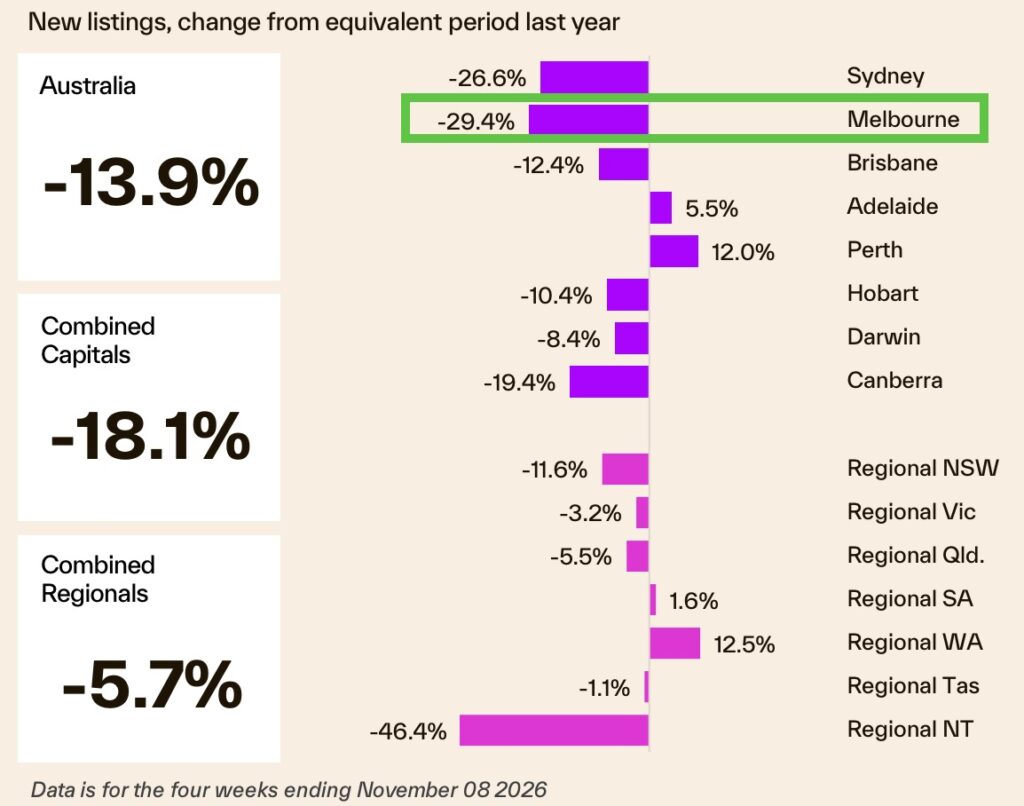
Melbourne has experienced a longer downturn period than other capitals. Vendors who are selling now are doing so because they need to sell. Nobody is floating their property on the market to test the buyers.
While buyers are tentative and anxious, those who are actively in the market now will attest to the conditions being reasonably competitive. Our significantly lower stock levels are creating competitive conditions in several facets of our market.
The vendors who are active include investors and upgraders. Plenty of investors are selling their investment properties. Rental reforms are onerous, and the holding costs have been driven up dramatically with interest rate hikes. Some are just approaching retirement and prefer to channel their capital into a more liquid asset class, such as shares.
Some owner occupiers are selling their homes and upgrading, because they are taking advantage of the market conditions. While the sale result is unfavourable, the percentage discount they potentially face on a higher-priced purchase is significantly higher than the sense of loss they will sustain on the sale.
But there is one other reason why Melburnian vendors are sitting tight. And that is the State election.
Agents have anecdotally shared feedback from prospective vendors. Many are ‘waiting to see’ what happens.
Could the mood shift? Could a newly elected government introduce policy changes that stimulate the market? Will buyer confidence increase?
These are all valid questions, and next Saturday’s election result may well breathe some fresh air into Victoria’s lungs.
One policy change that I believe will change our market if Liberal win relates to stamp duty for first homebuyers. A Jess Wilson government proposes to axe stamp duty for all eligible first homebuyers up to $1,000,000. This will have a significant impact on the lower and middle segments of the property market. It will likely segment the market further, and at a time when first homebuyers are only just starting to find their confidence and actively participate.
I’m not suggesting Melbourne is in recovery yet, but I do think the lower and middle segments of the market are worth watching closely over the coming months.