
Why three days isn’t always as simple as it sounds
A friend reached out to me recently on behalf of a contact of hers. Her contact had signed a contract to purchase a property, and when she later decided she wanted to exercise her cooling off rights, she found herself tangled in confusion about when her cooling off period had started and when it would end. The cooling off right is one of the most valuable protections a Victorian purchaser has, but it’s also one of the most misunderstood.

What the law provides
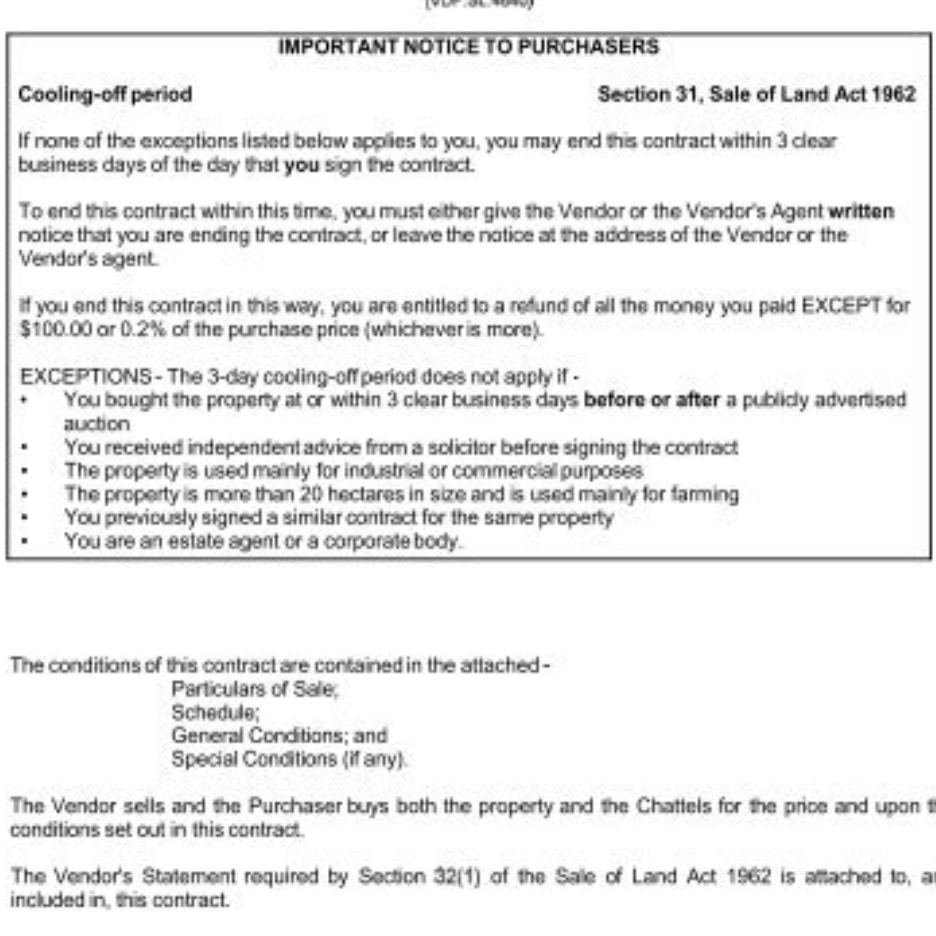
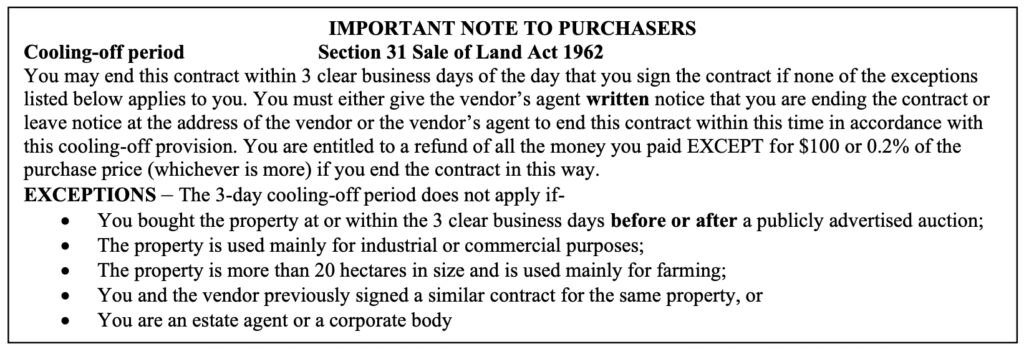
Under section 31 of the Sale of Land Act 1962, a buyer of residential property (or rural land under 20 hectares) purchased by private sale has three clear business days to change their mind. The buyer can end the contract for any reason, provided written notice is given within that window. If you cool off, you receive your money back less a modest penalty: the greater of $100 or 0.2 per cent of the purchase price. On a $900,000 purchase, that’s $1,800. It’s a significant amount, but a small price compared with being locked into a property you no longer want.
Unlike NSW and some other states, this right can’t be contracted away, either. Any term in a contract that tries to exclude, modify or restrict the cooling off period in Victoria is void.
Counting the three days
This is where much of the confusion starts. “Three clear business days” means the day you sign doesn’t count, and neither do weekends or public holidays. If an offer on a contract is signed on a Monday, the three days are Tuesday, Wednesday and Thursday. Any effort to cool off would need to be done within this window. If a contract is signed on a Thursday, the window runs Friday, Monday and Tuesday. If we add a public holiday into the mix, the end date shifts to the following day; Wednesday.
Crucially, the clock starts from when you, the buyer, signs the offer, not when the vendor signs. Many buyers assume they have three days from the moment the vendor accepts, but if the vendor takes a day or two to sign, those days are already eating into the buyer’s window.
The cooling off clock starts with your signature, not the vendor’s.
While the law doesn’t specifically state a time for cooling off expiration, it is highly recommended across many lawyer and conveyancer circles to adhere to business hours. The exact cutoff hour can be a grey area in the legislation, and given the notice needs to be in writing, it his recommended that buyers who wish to cool off do not leave this to later in the evening on teh third day.
When the offer changes in the days that follow
This is a scenario that often trips people up. A buyer signs a contract at a certain offer price. The vendor doesn’t accept, and comes back with a counter offer. A day or two later, the buyer agrees to the higher figure, and the price is amended and initialled on the contract. Which date counts?
The Act ties the period to the date the purchaser signs. If the buyer re-signs the same contract with an amended and initialled price, the cooling period still runs from the original contract date. Where a change is simply initialled rather than re-signed, the buyer cannot assume that their cooling off period restarted.
However, if a buyer signs a fresh contract with their updated offer, the clear date on that contract page clearly demonstrates that the cooling off period starts from that day.
If a buyer makes a verbal offer, or expresses their offer in writing via a text message or email, there is no contract to refer to yet, hence the cooling off period is not calculated as applying from that day. The cooling off period only applies when an offer is made and signed on a contract of sale.
It’s also worth remembering that until the vendor has accepted, there is no contract. Up to that point a buyer can simply withdraw their offer in writing, which is a different mechanism from cooling off.
Unless a number of days is specifically noted on the signature page of the Victorian contract of sale, the REIV contract provisions for the offer to lapse after three clear business days.
When cooling off doesn’t apply
The right to cool off doesn’t exist for every purchase. It doesn’t apply if you buy at a publicly advertised auction, or within three clear business days before or after an auction, which captures the common scenario of negotiating on a property that has passed in. It also doesn’t apply to commercial or industrial property, farming land over 20 hectares, buyers who are estate agents or companies, or where you have previously signed and executed a contract for the same property on substantially the same terms.
How to cool off properly
If a buyer decides to cool off, the notice must be in writing, signed by the purchaser, and delivered (in person or via email) to the vendor or their agent within the window. A phone call or a text message to the agent does not suffice. We also recommend getting the buyer’s conveyancer or solicitor involved immediately, and lodging the notice well before the final day rather than in its closing hours.

Being clear on the reasons why the contract is being exited
Sometimes buyers will receive a building and pest inspection report that is alarming enough to make them wish to exit the contract. Depending on the wording of the condition in the executed contract, they may not be legally entitled to exit for reasons based on building and pest inspection clause. Maybe the clause states “major pest infestation” or “major structural defect”. This is quite different to “a major defect in a structure”, after all, the dwelling is a structure.
But a structural defect is different from a plumbing defect. The wording is essential to understand.
A buyer who has a building and pest inspection clause for seven days may not have the protection they need if their clause states “major structural defect”. It is for this reason that it is imperative that they receive the report within the cooling off period if they are concerned about the potential existence of other major defects. They may need to exercise the cooling off period, as opposed to their right to exit on the back of the building and pest inspection clause.
If their communication to exit the contract states that they are relying on their building and pest inspection condition, it may be possible that the validity of their ability to exit is in question. If the wording of the clause precludes them from being able to exit the contract, they won’t be able to exit under the cooling off provision if the three day period has passed….. even if they communicated their desire to exit via the building/pest inspection clause within three business days.
In conclusion
Cooling off is a safety net, not a strategy. The best protection involves having the contract thoroughly reviewed, and conducting all due diligence prior to signing. But buyers do need to be clear on the day that their cooling off period commences in case they need this safety net for any particular reason.
Count from the moment you first sign, and never leave your decision to the last day.