
Victoria’s New Auction Rules: More Disclosure, Less Transparency?
Transparency is a worthy goal, but a disclosure document is only ever as useful as the information it actually contains. Victoria’s new underquoting reforms took effect on 1 October, and from this weekend every auction and fixed-date sale must have the vendor’s reserve price published at least seven days beforehand. Buyers have been told this is a win for them. In my view, the picture is far more mixed, and in several respects, buyers may end up worse off.
The Property Price Statement gives buyers a false sense of security.
The Property Price Statement (PPS) now replaces the former Statement of Information. It nominates the reserve and sets out the comparable sales the agent has selected to support their estimated selling price. On paper, that sounds robust. In practice, the PPS describes a property using a very narrow set of attributes: square meterage for land and dwelling, bedroom, bathroom and car space count, and the style of dwelling.
What it doesn’t capture is almost everything that determines whether a property has fundamental flaws or a dwelling that is in need of serious expenditure. There is no reference to land use, zoning or planning overlays, all of which can dramatically change what a site is worth and what can be done with it. There is nothing on the condition of the dwelling, so a freshly renovated home and one in need of a complete overhaul can be presented side by side as comparable. And there is no recognition of negative surrounds: a main road, a train line, an industrial building next door, airport noise or high voltage power lines overhead.
Two properties can match perfectly on paper and be worlds apart in value.
Any experienced buyer’s agent will tell you these factors can impact value significantly. A buyer relying on the PPS to set their budget is working from a document that leaves out much of what determines value, which makes its broad reliability questionable at best.

Conservative reserves and the likelihood of a pass-in
The second issue is behavioural. When a reserve has to be published a week out, vendors and agents are likely to quote it more conservatively, because vendors are nervous about the idea of underselling their asset. A vendor who publishes a figure is unlikely to want it read as an invitation to buy at that price, so there is a real risk of reserves being set above the number the vendor would genuinely accept on the day.
Without the benefit of buyer interest firming up in those those last days of the campaign, a vendor is less equipped to rely on the buyer feedback when it comes to etting their reserve.
Any agent will confirm this: most of the buyer confirmation comes in the final days. Requests for settlement terms, building inspections and deposit discussions usually occur in the final days. Not seven days prior.
The likely result is more properties passing in, with the real negotiation then happening privately inside. That strips away a large part of what makes an auction valuable to buyers in the first place: open competition, visible bids and a clear, public outcome. A pass in negotiation takes us straight back behind closed doors. That transparency is then gone.
The pivot to private sale
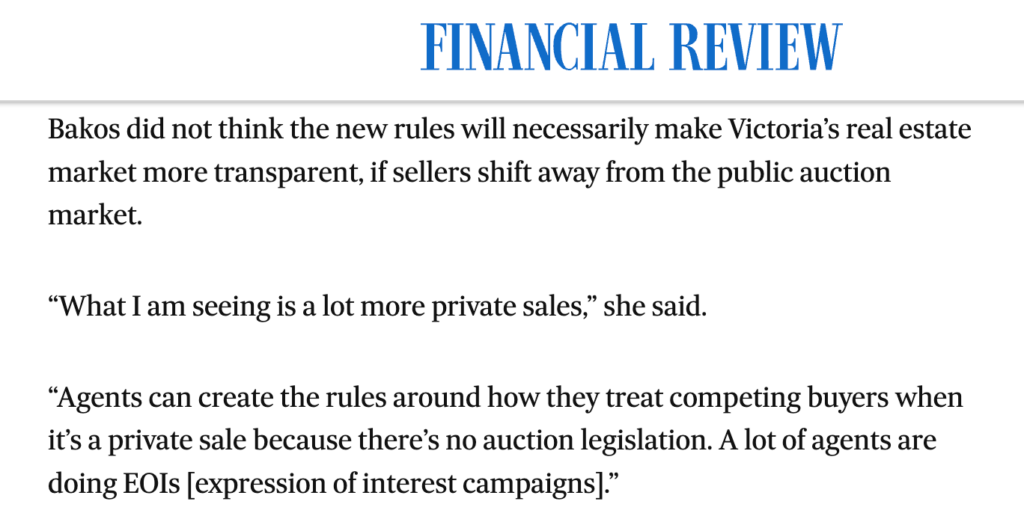
We are already seeing the flow on effect. The legislative changes have triggered a higher blend of private sales relative to auctions, because private sales aren’t governed by the same strict rules around agent conduct that auctions are.
For buyers, a private sale can bring a far greater level of stress and mystery. Private campaigns frequently run as “best and highest” processes, where you can’t see competing offers, you can’t see what anyone else is willing to pay, and you are often told about other buyers and other offers that you have no way of verifying. Pair that with a PPS of limited reliability and many buyers are effectively flying blind. Once again, the loser is the buyer.
The change I do agree with
There is one change I wholeheartedly welcome, and that is mandatory sold price disclosure. Agents must now update the PPS with the final sold price within seven days of a sale becoming unconditional. This sold result information must then remain publicly available for 18 months.l
After decades of “price withheld” and “contact agent”, this is a positive change. Buyers will finally be able to piece together their own comparable sales analysis from real, verified results, rather than relying on a small number of questionable (and usually inferior) ‘comparable sales’ printed on the back of a sheet. Sold price disclosure gives buyers far more confidence when they set their price limits, and it is the part of these reforms that I believe will deliver lasting value.
What buyers should do now
Buyers should not assume that the stated reserve is the minimum price that the vendor will accept on the day of auction. If the property passes in, a buyer can still offer a lower price and treat the task as a negotiation.
The PPS should not be relied upon blindly. Buyers should check the zoning and overlays themselves, including those of the comparable sales in the PPS. There are a few free portals available for this.
Buyers should also conduct their own due diligence, including a building and pest inspection, a thorough legal review and price comparison of other recently sold properties.